RSS

Category Archives: classics challenge

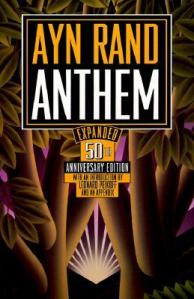
Classics Challenge – Anthem – Ayn Rand

anthemAnthem
Author: Ayn Rand

Description:
In Anthem, Rand examines a frightening future in which individuals have no name, no independence, and no values. Equality 7-2521 lives in the dark ages of the future where all decisions are made by committee, all people live in collectives, and all traces of individualism have been wiped out. Despite such a restrictive environment, the spark of individual thought and freedom still burns in him–a passion which he has been taught to call sinful. In a purely egalitarian world, Equality 7-2521 dares to stand apart from the herd–to think and choose for himself, to discover electricity, and to love the woman of his choice. Now he has been marked for death for committing the ultimate sin. In a world where the great “we” reign supreme, he has rediscovered the lost and holy word–“I.”

Why I choose this “classic”:
When I was putting together my list of books for this challenge, I knew that I wanted to include some Ayn Rand because her name had been mentioned so often in the 2012 election season. However, the sheer size of Atlas Shrugged and the Fountainhead scared me. But Anthem coming in at only a couple of hundred pages seemed do-able (and to test my mettle, I added fountainhead in one of my other categories). Anthem fit well into my dystopia theme – although the year is unmentioned.

Review:
This was a hard review to write – I actually finished the book back in the first week of December, but I knew that I wanted to mull over it a bit before posting my review – like I tend to do with many classics. The first thing that caught my eye/ear when I was listening (yes, this is an audiobook review) was the introduction that was written for the 50th anniversary edition by Leonard Peikoff. Peikoff is a philosopher and founder of the Ayn Rand Institute – he had some interesting things to say, not only about Rand’s philosophical leanings, but her experiences in general in the writing of the book – the fact that she completely re-wrote it prior to its release in the US in the 1940’s as she improved on her writing style. This introduction for me helped set the book and gave some foundation to it, which I think added to my thoughts on it. The most intriguing part of the intro was where Peikoff highlighted the fact that Anthem wasn’t the original name of the book, its working title (and the title I think more appropriate) was EGO…

When I heard that, my ears pricked up, because I realized while there was the ego that we refer to as he’s so egotistical, I thought about the ego theory developed by Freud. I’m not sure which one specifically she had in mind as she was writing the book because I think both could work – so that was an intriguing thought. For a book that was written back in the 1930’s/40’s – I appreciate that she didn’t write a specific year for the setting, just used an undisclosed future – because I’ve found if they set a year, and then you read that book after the setting and stuff hasn’t occurred it takes away from the intended affect.

Some of the themes in this reminded me of ones that have appeared in more recent dystopian fiction – for example, the assigning of jobs has shown up in The Giver (Lois Lowry) and the Matched Trilogy (Ally Condie) – and yet, it had its own uniqueness still. I had to chuckle at the part where he (Equality 7-2521) discovered electricity and when presented with the information, the world council was afraid that with that, the candle-makers would be put out of work…kind of reminded me of working in the federal government where at times there are remarkable amounts of redundancies and you question the need for them, but people continue to argue that they are needed…

I have a hard time figuring out who exactly I would recommend this to, because it wouldn’t be to most of my reading buddies. Maybe anyone interested in philosophy; people who are looking for thought-provoking reads…I shall have to ponder that some more. Would I read this again – I don’t think so, but it was intriguing and now I am kind of curious to see what Rand wrote in the Fountainhead…but i’m not quite ready to read it yet – maybe in the next year or so. Even with my abundance of reading, I need to review my critical thinking skills before tackling it.
 
2 Comments

Posted by on December 29, 2012 in classics challenge


Tags: , , , ,

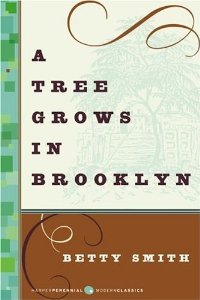
Classics Challenge – A Tree Grows in Brooklyn – Betty Smith

A Tree Grows in Brooklyn
Author: Betty Smith
Classics Challenge Sub-topic: Coming of Age

Book Description:
The story of young, sensitive, and idealistic Francie Nolan and her bittersweet formative years in the slums of Williamsburg has enchanted and inspired millions of readers for more than sixty years. By turns overwhelming, sublime, heartbreaking, and uplifting, the daily experiences of the unforgettable Nolans are raw with honesty and tenderly threaded with family connectedness — in a work of literary art that brilliantly captures a unique time and place as well as incredibly rich moments of universal experience.

Review:
I probably never would have put this book on my challenge to read list if it hadn’t shown up as a group read in one of my various goodreads groups. But now that I have read it, I can’t believe that I hadn’t before. And come to think of it, I don’t recall even really hearing about it – although apparently it is still used on school reading lists. (My library has all the reading list books separated from the standard YA, so they are easy to find).

A Tree Grows in Brooklyn is such a simple tale – the story of Francie growing up in Williamsburg, a part of New York (although every time I see that town name, I think of Williamsburg, VA). She goes through the same trials that most kids do – going to school, dealing with boys, first love, but on top of all that, an alcoholic father and being exceptionally poor. I loved seeing her mother (who some reviews describe as being cruel, although I don’t agree) teaching Francie and her brother about the value of money and saving towards a goal (with the tin cup that they nailed in the cupboard at each house they moved to). Or the love of learning that she inspired in them, through Shakespeare and the bible.

Even now, over 60 years since it was originally written, I can see how kids can relate to the going-ons. Not necessarily the time period specific, but the general themes of growing up and finding your place in the world. Being the sucker that I am for happy endings, I wonder what would happen if a sequel was ever written – What did Francie end up doing with her life – Did she finish going to college? Did she get over her first love and subsequent first heartbreak? But at the same time, I don’t want to know because I can imagine various different endings all I want and a sequel would change that.

This is a book that I would recommend to pretty much anyone, but I do think that teenage girls would enjoy it the most because of the themes and the characters.

 
4 Comments

Posted by on November 8, 2012 in classics challenge


Tags: , , , , , , ,

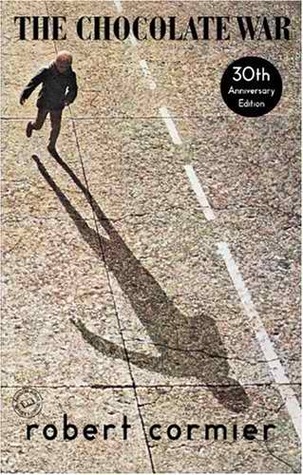
Classics Challenge Review – The Chocolate War – Robert Cormier

The Chocolate War
Author: Robert Cormier

Narrator: Frank Muller
Run Time:5hrs and 34 minutes

Book Description:
Jerry Renault ponders the question on the poster in his locker: Do I dare disturb the universe? Refusing to sell chocolates in the annual Trinity school fund-raiser may not seem like a radical thing to do. But when Jerry challenges a secret school society called The Vigils, his defiant act turns into an all-out war. Now the only question is: Who will survive?

Review
When I originally picked The Chocolate War by Robert Cormier to read for my 50 classics in 5 years challenge, I thought that it was because I had read it as a teen and wanted to re-read it to see how my opinion of it had changed over the years. However, I soon discovered that it wasn’t the book that I thought it was…(and unfortunately, I still haven’t figured out what that damn book it yet!!). But at the same time, I am glad that I chose to read/listen to it, but have decided that I need to pick up the second one (Beyond the Chocolate War), because I wasn’t all that impressed with the ending – it was too vague and unfinished for me.

However, the quote that continually shows up through the book – “dare I disturb the universe” is key to the events that unfolded through-out the course of the book. It is a question that so many people who engage in social protest ask themselves – is that one small action I might engage in, worth it. Will I succeed in what I am about to do? What are the consequences for me engaging in this action? It was interesting to hear, in the authors own words, how he came up with the idea for the book (his son who refused to sell school chocolates) and how his various what-if scenarios played out in the development of the various characters. Not only does the theme of social protest appear through-out but the idea of the role of bullying in society.

It was bullying by the group called the Vigils that started the chain of events that led to the events that occurred in the books; it was the bullying of Brother Leon of many of the students at the school that led to the culture where the Vigils flourished and were allowed to behave as they did. Like i mentioned above however, my main problem with how the book finished was that there was no real ending – the good guy (in this case, Jerry) didn’t prevail, we were kind of left wondering what happened or worse yet, left with the impression that evil will prevail and that it will beat good out every time. So I am curious to see what happens in the second book.

I found the narration by Frank Muller interesting – it seemed much more like a performance than the straight reading of a book. This isn’t something that I often run into when listening, so it was interesting. At first it was weird, but it kind of grew on me as the book progressed. He did have a good ability to have some fear inspiring voices like his rendition of Brother Leon. i have to say though, that since the entire cast of characters are male, there was really no way for me to judge how his female voices would sound – so I would be curious to listen to other narrations by him to find out how he renders those.

If the other books in my classics challenge are as thought provoking as this one, I look forward to reading more.

 
2 Comments

Posted by on October 29, 2012 in Audiobook Review, classics challenge


Tags: , , , , , ,