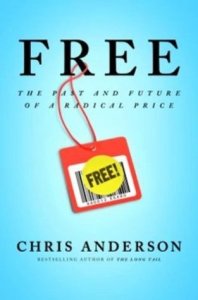
 Free: The Future of a Radical Price
Author: Chris Anderson
Rating: ☆ ☆ ☆
Dewey Decimal Challenge: 658 General management
Description:
Far more than a promotional gimmick, Free is a business strategy that may well be essential to a company’s survival. The costs associated with the growing online economy are trending toward zero at an incredible rate. Never in the course of human history have the primary inputs to an industrial economy fallen in price so fast and for so long.
Just think that in 1961 a single transistor cost $10; now Intel’s latest chip has two billion transistors and sells for $300 (or 0.000015 cents per transistor – effectively too cheap to price). The traditional economics of scarcity just don’t apply to bandwidth, processing power, and hard-drive storage. Yet this is just one engine behind the new Free, a reality that goes beyond a marketing gimmick or a cross-subsidy.
Anderson also points to the growth of the reputation economy; explains different models for unleashing the power of Free; and shows how to compete when your competitors are giving away what you’re trying to sell.
Review:
Its been a while since I’ve dabbled in my Dewey Decimal Reading Challenge. Not that I haven’t been reading any non-fiction, I still probably average a book a month – but I definitely fell into my comfort zone of biographies since I stopped blogging. So a SRC (Seasonal Reading Challenge) task to read a non-fiction book that had been shelved as Economics seemed like a good way to get back to it.
Free is a word when it comes to services that we think a lot about. For many of us, we use many free services every day – especially if you are on social media – Facebook, Twitter, Instagram are all free. For the readers among us, Goodreads is free or my other often used site MyFitnessPal (where there is a free and a premium option). Most recently Strava, a running/cycling app, announced that many of the benefits that used to be free were now going to be exclusive to members (for $4 a month) – but the number of people I observed who talked about no longer using was significant. Chris Anderson’s book talks about how services can offer, what are oftentimes robust, services for free. How they can pursue funding with limited costs and other economic benefits.
Honestly, many of the things he touched on, I had never really considered. I’ll admit (guiltily) that I spend a significant amount of time of Goodreads most days which is a prime free site for readers; I’ll also admit that I pay the premium fee for MyFitnessPal (mostly because it allows a slightly greater level of customization that I enjoy). This book made me things about free, nearly free and services that cost. It was kinda dry at times (but honestly that is just economics in general for me – i think i went through 5+ books for this task – all borrowed free from my library – before settling on this book).
Overall 3 stars.
 Dee's Book Blog